


Premium finance life insurance is a lending strategy that allows high-net-worth families to pay large life insurance premiums with a bank loan rather than cash on hand or liquidated assets. A common question we hear is whether Premium Finance Life Insurance is right for a given family, and the honest answer depends on the planning goal, comfort with variable-rate borrowing, and whether there is a repayment plan that does not rely on the death benefit. This guide covers what premium financing is, how premium financing works, who qualifies, the real risks, and a compliance-cleared next step. Along the way, we keep premium financing explained in plain terms so readers can weigh the strategy with clear eyes, not optimistic projections.
This content educates and does not give advice. Outcomes depend on underwriting, lender terms, policy performance, and tax and trust structure, and U.S. Bank stresses the need for experienced teams and tax and legal advisors.
TL;DR: What You Need to Know
- Loan sizes are large. U.S. Bank describes premium finance loan amounts that typically range from $1M to $10M, usually as a one- to five-year term or multi-advancing term loan.
- Rates are variable. Premium finance interest is typically tied to the prime rate or SOFR, so a change in benchmark rates flows straight through to borrowing cost.
- Borrowing costs have trended lower. The 90-day average SOFR fell from roughly 5.35% in July 2024 to roughly 4.34% in July 2025 and roughly 3.63% by July 2026, according to Federal Reserve Bank of St. Louis data on the 90-day average SOFR.
- Collateral gets watched daily. J.P. Morgan notes that a collateral shortfall may lead to a margin call, and U.S. Bank describes daily monitoring of liquid collateral.
- The death benefit cannot be your repayment plan. U.S. Bank states that the ultimate source of loan repayment must be identified and cannot be the death benefit.
Is premium finance right for you?
Wondering whether premium finance life insurance fits your situation? A Discovery Call with Crossfield Strategic Partners is a no-obligation conversation about your goals, your coverage needs and how the financing would work.
What is premium finance life insurance?
Premium finance life insurance is a way for high-net-worth individuals and families to pay life insurance premiums without using cash or liquidating assets, as U.S. Bank defines it directly. Instead of paying premiums out of pocket, a borrowing entity takes out a bank loan to fund those premiums, then pledges collateral and services the interest.
The strategy tends to surface in the context of permanent life insurance because the planning goal is often long-term. One common motivation is estate tax liquidity: permanent life insurance proceeds can help address an estate tax bill so heirs avoid a forced sale of illiquid assets or business interests, a rationale U.S. Bank spells out. That said, the federal estate tax exemption did not shrink as many expected heading into 2026. The Tax Cuts and Jobs Act’s doubling of the exemption was scheduled to expire after 2025, but Congress made it permanent and set the exclusion at $15 million for 2026 under Public Law 119-21, as described in a Congressional Research Service explainer on the estate tax exemption. That means premium finance life insurance should not be pitched as solely an estate tax play. It also shows up in business succession and buy-sell funding, liquidity planning for concentrated or illiquid holdings, and situations where a family wants to avoid selling appreciated assets at an inopportune time.
Here is the phrase to be careful with. Any pitch framed as “zero premium,” “no cost,” or “free” insurance can overlap with patterns regulators warn about. The Illinois Department of Insurance flags “zero premium life insurance” and “no cost” language and references non-recourse premium finance transactions in its stranger-originated life insurance guidance. That is not the strategy described here.
How does premium finance life insurance work?
premium finance life insurance works by placing a life insurance policy inside a borrowing structure, funding the premiums with a bank loan, and securing that loan with collateral that the lender monitors over the loan term. To keep the mechanics of premium financing grounded in fact rather than sales theater, here is the mechanical flow, drawn from bank descriptions.
An irrevocable life insurance trust, or ILIT, usually serves as the borrowing entity in U.S. Bank’s description. There is a technical reason trust ownership comes up so often: U.S. estate tax law can pull life insurance proceeds into the gross estate under certain circumstances, including “incidents of ownership,” under 26 USC Section 2042 and its regulatory interpretation at 26 CFR Section 20.2042-1. How ownership is structured is a legal question for an attorney, not something to be handled on your own.
On the policy side, whole life or indexed universal life are the types U.S. Bank describes as typically used in premium financing. This guide is limited to these non-variable permanent policies. Variable universal life is a securities product subject to both state insurance and federal securities laws, as FINRA notes, and must be handled by a securities-licensed representative; it is outside the scope of this guide.
Why the rate environment matters right now
Because premium finance loans typically float with a benchmark, the direction of that benchmark changes the math families run before committing. The 90-day average SOFR moved from approximately 5.35% in early July 2024 to approximately 4.34% in early July 2025, and down to approximately 3.63% by mid-July 2026, according to Federal Reserve Bank of St. Louis SOFR data. That is a meaningful directional shift, roughly 1.7 percentage points over two years. It does not remove the risks of premium financing, and it should not be read as a promise that rates will continue to fall. It simply changes the starting point for interest carry and for the rate scenarios a lender or advisor should run. A sound planning conversation asks how the structure performs if the benchmark rises 2, 4, or 6 percentage points from today, not just how it performs at the current rate.
Who qualifies for premium finance?

Premium finance is built for high-net-worth individuals and families who can pledge meaningful collateral and who want to fund large premiums without using cash or selling assets. That is the profile U.S. Bank uses to describe the strategy. We are not going to invent a hard net worth minimum because the sources do not state one. What the sources do make clear is the documentation and collateral bar.
U.S. Bank lists medical underwriting, a pledge of collateral in the form of liquid assets and/or policy cash value, and full financial disclosure. That disclosure includes a personal financial statement or balance sheet; the most recent three years of tax returns with schedules and K-1s; liquidity verification; daily monitoring of liquid collateral; carrier reporting; the ILIT agreement; and policy illustrations. Business owners, physicians, and attorneys with complex balance sheets should expect this level of scrutiny as standard practice rather than a red flag.
Fit is also about temperament. This is a borrowing strategy that can involve interest-rate fluctuation, market volatility, and collateral shortfall, leading to a margin call, which J.P. Morgan names directly. If a margin call would keep a family up at night, that is useful information about whether the strategy fits in the sense that matters most.
Underwriting itself is also evolving. The National Association of Insurance Commissioners has been developing guidance on accelerated underwriting and external data analytics, which affects how large cases are documented and reviewed, per the NAIC’s resources on accelerated underwriting. Families pursuing large face amounts should expect more documentation and governance around underwriting inputs, not less, as this area matures.
What are the benefits of premium finance life insurance?
The core benefit of premium finance life insurance is keeping cash available: a family can fund large life insurance premiums without using cash on hand or liquidating assets, which U.S. Bank identifies as its central purpose. For someone whose assets are concentrated in a business or in appreciated positions, not selling can matter for both control and tax reasons.
The second benefit is planning capacity. Permanent life insurance can supply estate tax liquidity so heirs are not forced to sell illiquid assets or business interests to cover a bill, a use case U.S. Bank describes. Death benefits paid on account of death are generally excluded from income, per IRS Publication 559 and the statutory baseline in 26 U.S.C. § 101. That exclusion is not automatic in every situation — consult your tax advisor to understand how these rules apply to your specific circumstances. The IRS notes that if a policy was transferred for valuable consideration, the exclusion may be limited, which is one more reason structure gets reviewed by professionals.
A third factor is product fit. U.S. Bank notes that whole life and indexed universal life designs with high early cash value are typical choices in premium financing, which helps explain why lender and policy conversations often center on these product types.
What are the risks of using borrowed money for life insurance premiums?
The risks of using borrowed money for life insurance premiums cluster around three moving parts: the rate, the policy, and the collateral. Each can turn a projection into a problem. This is where premium financing explained parts ways with the “free insurance” narrative.
Interest rate risk. Because premium finance interest is variable and tied to prime or SOFR, rising benchmark rates raise the cost of the loan. SOFR is published by the New York Fed and measures the cost of overnight borrowing collateralized by Treasuries, so it moves with market conditions that no borrower controls. Even though the benchmark has trended down from 2024 into 2026, a well-run plan should be carefully structured around changing loan-rate scenarios, including a meaningful rate increase, rather than built on the assumption that low rates persist.
Market volatility and policy performance. U.S. Bank explicitly highlights the risk that a policy may underperform due to market volatility. If the policy’s cash value grows more slowly than the illustration assumes, the whole plan gets tighter.
Collateral shortfall. A shortfall may lead to a margin call, as J.P. Morgan states. U.S. Bank’s broader guidance on liquid-asset secured financing explains that if collateral values fall, borrowers may have to repay part of the loan, provide additional collateral, or sell assets, and selling can create tax liability.
The “free insurance” myth. U.S. Bank identifies the misconception that premium financing is “free” when collateralized by cash value and ties it to optimistic assumptions about performance and rates. It also emphasizes the need for a repayment plan other than the death benefit. There is a tax dimension, too: with a permanent policy, a lapse or surrender while a loan is outstanding can trigger a taxable event, and whether a distribution is taxed also depends on Modified Endowment Contract status, defined in 26 USC Section 7702A. Consult your tax advisor.
Regulatory scrutiny of aggressive structures. Regulators have long watched for financing structures paired with quick transfer intent, a pattern associated with stranger-originated life insurance. An SEC staff report on life settlements discusses how model acts try to deter these arrangements and references conditions such as the presence or absence of premium financing in certain safe-harbor contexts, per the SEC’s special study report on life settlements. A legitimate premium finance strategy is built around a family’s own protection and legacy goals, not around a plan to sell the policy to third-party investors.
Understand the risks for your plan
Every premium finance life insurance plan carries interest-rate, lender and policy-performance risk. On a Discovery Call, we walk through how those risks would apply to your specific situation before anything moves forward.
Comparison Table: Structural Choices in Premium Finance Life Insurance
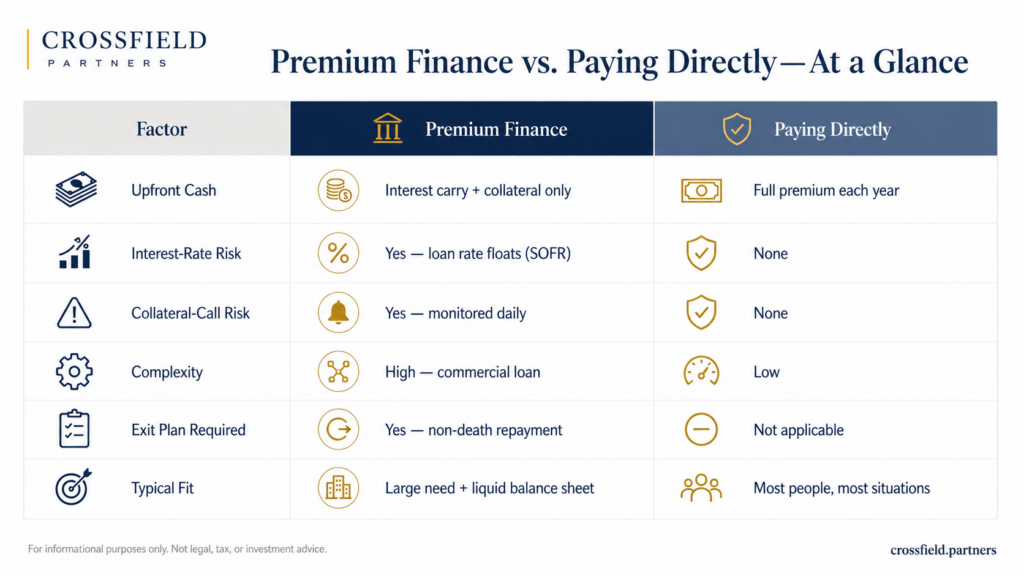
Each choice below carries different mechanics. Use this to frame conversations with advisors, not as a recommendation.
| Choice | Option A | Option B | What the sources say |
| Funding method | Pay premiums with cash | Premium Finance Life Insurance | Financing avoids using cash or liquidating assets but adds variable-rate cost and collateral monitoring with potential margin calls |
| Loan form | Term or multi-advancing term loan, one to five years | Line of credit | Term or multi-advance is common per U.S. Bank; a line of credit is described by J.P. Morgan |
| Rate benchmark | Prime-based | SOFR-based | Both are variable options per U.S. Bank; SOFR reflects overnight Treasury-collateralized borrowing |
| Policy type | Whole life or indexed universal life | Variable universal life (out of scope) | Whole life and indexed UL are typical per U.S. Bank. Variable universal life is a securities product subject to state insurance and federal securities laws, per FINRA, and must be handled by a securities-licensed representative; it is not covered in this guide |
A Premium Finance Life Insurance Checklist: Steps From Goal to Ongoing Management
This numbered checklist tracks only what the sources support. It is a map, not a substitute for a legal, tax, and lending team.
- Confirm the planning goal and borrowing rationale. Decide whether the point is estate tax liquidity, business succession funding, or avoiding asset sales, as U.S. Bank describes.
- Establish the ownership and borrowing entity. An ILIT usually serves as the borrower, per U.S. Bank; coordinate with an attorney given estate-inclusion sensitivity under 26 USC Section 2042.
- Apply for insurance and complete medical underwriting. U.S. Bank notes underwriting may run at the same time as the loan application.
- Select the loan structure and understand the pricing benchmark. Compare a term or multi-advancing term loan against a line of credit, and confirm whether pricing follows prime or SOFR.
- Provide lender documentation and pledge collateral. Expect to supply three years of tax returns with K-1s, liquidity verification, the ILIT agreement, and policy illustrations, with daily monitoring of liquid collateral.
- Identify the repayment source and define a repayment plan that does not rely on the death benefit. U.S. Bank states the ultimate source of repayment must be identified and cannot be the death benefit.
- Service periodic interest during the term. Interest, not principal, is required during the loan term per U.S. Bank.
- Model the loan against rising rates. Run the plan at multiple benchmark scenarios above the current rate, given that the 90-day average SOFR has moved substantially over the past two years per Federal Reserve Bank of St. Louis data.
- Manage the strategy on an ongoing basis. Plan for the possibility that a collateral decline means the borrower must repay part of the loan, add collateral, or sell assets, any of which can carry consequences.
An extra note on step five: because these strategies lean on long-range projections, illustration governance matters. The NAIC works on life insurance illustration requirements, and its Model Regulation was last revised in September 2024 with a December 1, 2024, effective date per the American Academy of Actuaries. Read illustrations as scenarios, not promises.
Why Premium Finance Life Insurance Is Showing Up More Often
More people are asking what premium financing is because the underlying market keeps setting records. U.S. individual life insurance new annualized premium reached $15.9 billion in 2024, up 3%, then topped $17.5 billion in 2025, up 10% year over year. Financing often targets permanent products such as indexed universal life and whole life.
At the same time, borrowing costs have eased. The 90-day average SOFR fell from roughly 5.35% in July 2024 to roughly 3.63% by July 2026, per Federal Reserve Bank of St. Louis SOFR data, a shift the National Association of Insurance Commissioners ties back to the Federal Reserve’s rate-cutting path that began in mid-2024, according to the NAIC’s overview of interest rates and insurance. Lower floating-rate costs change the starting math for interest carry, even though a well-run plan still has to account for the possibility that rates rise again before the loan is repaid. Rising premium volume, a permanent estate tax exclusion set at $15 million for 2026, and a more favorable starting rate environment together explain why premium financing keeps coming up in planning conversations, even for families whose primary goal is not estate tax liquidity.
Frequently Asked Questions
What is premium finance life insurance?
Premium finance life insurance is a strategy in which a borrowing entity uses a bank loan to pay life insurance premiums instead of paying with cash or selling assets, a method U.S. Bank defines for high net worth individuals and families. It is typically paired with permanent policies such as whole life or indexed universal life. It is not “free” insurance, and any pitch using that language deserves scrutiny.
How does premium finance life insurance work?
Life insurance premium financing works by putting a policy inside a borrowing structure, often an ILIT, funding premiums with a bank loan, and pledging collateral that the lender monitors. U.S. Bank describes loans of $1M to $10M as term or multi-advancing term loans over one to five years with variable interest tied to prime or SOFR. Borrowers service periodic interest payments during the term and must identify a repayment source other than the death benefit.
Who qualifies for premium finance, and what documentation is typically required?
Premium finance generally fits high-net-worth individuals and families who can pledge substantial collateral and complete full financial disclosure. U.S. Bank lists medical underwriting, a collateral pledge, three years of tax returns with K-1s, and liquidity verification among the requirements. Beyond the numbers, qualifying also means being comfortable with variable rates and the possibility of a margin call, which J.P. Morgan flags.
Talk it through with Crossfield
When you are ready to explore premium finance life insurance for your family or business, book a Discovery Call with our team. We will review your goals, your coverage needs and the lending terms that would apply.
Premium finance uses a loan to pay life insurance premiums and involves interest-rate, lender and policy-performance risk. This is not investment, tax or legal advice.
Important Disclosures
Premium finance life insurance involves borrowing through a third-party lender and carries material risks. Interest rates are variable and tied to benchmarks such as SOFR or the prime rate; your borrowing cost will change as market rates change. Policy performance is not guaranteed; if cash value grows more slowly than illustrated, the strategy may not perform as projected. A collateral shortfall can result in a margin call requiring you to repay part of the loan, contribute additional collateral, or sell assets. This content is educational and does not constitute a recommendation. Suitability depends on your individual financial situation, risk tolerance, and planning objectives. Not suitable for all clients. Consult your licensed life insurance producer, attorney, and tax advisor before entering into any premium finance arrangement.
Not a deposit. Not FDIC-insured. Not insured by any federal government agency. Not guaranteed by, or an obligation of, any bank or bank affiliate. May lose value.
Life insurance products are not securities or investment products. This is not investment advice.
Values shown are non-guaranteed projections based on current assumptions. Actual results will vary. Past performance is not indicative of future results.
Tax treatment depends on individual circumstances. Consult your tax advisor.
Crossfield Strategic Partners is not affiliated with, endorsed by, or sponsored by U.S. Bank, J.P. Morgan, or any other institution referenced in this guide. All third-party references are cited for educational and illustrative purposes only.
Works Cited
Congressional Research Service. Estate Tax: An Overview of the Issues. Updated 2026. Discusses Public Law 119-21 and the permanent $15 million exemption for 2026.
Federal Reserve Bank of St. Louis. 90-Day Average SOFR. FRED Economic Data. Data cited for July 2024, July 2025, and July 2026.
Illinois Department of Insurance. Stranger-Originated Life Insurance Guidance. References “zero premium” and “no cost” language and non-recourse premium finance transactions.
Internal Revenue Service. Publication 559: Survivors, Executors, and Administrators. Covers income exclusion for death benefits.
J.P. Morgan. Liquid Asset Secured Financing Overview. References margin call risk and line-of-credit loan structures in premium finance.
LIMRA. U.S. Individual Life Insurance Premium Sales Records (2024 and 2025). Reports $15.9 billion in new annualized premium in 2024 and $17.5 billion in 2025.
National Association of Insurance Commissioners. Accelerated Underwriting Resources. Guidance on external data analytics and large-case documentation.
National Association of Insurance Commissioners. Interest Rates and Insurance Overview. References the Federal Reserve’s rate-cutting path beginning mid-2024.
National Association of Insurance Commissioners. Life Insurance Illustration Model Regulation. Revised September 2024, effective December 1, 2024, per the American Academy of Actuaries.
New York Federal Reserve. Secured Overnight Financing Rate (SOFR). Benchmark rate data referenced throughout.
U.S. Bank. Premium Finance Life Insurance Overview. Primary source for loan structure, collateral requirements, documentation standards, repayment rules, and policy types.
U.S. Code, Title 26, Section 101. Statutory baseline for income exclusion of death benefits.
U.S. Code, Title 26, Section 2042. Estate inclusion rules for life insurance and incidents of ownership.
U.S. Code, Title 26, Section 7702A. Definition of Modified Endowment Contract.
U.S. Code of Federal Regulations, Title 26, Section 20.2042-1. Regulatory interpretation of estate inclusion for life insurance.
U.S. Financial Industry Regulatory Authority (FINRA). Variable Life Insurance. Notes that variable life is subject to both state insurance and federal securities laws.
U.S. Securities and Exchange Commission. Special Study: Life Settlements. Discusses model acts deterring STOLI arrangements and premium finance in safe-harbor contexts.


Comments are closed